Tuesday, May 20, 2014

Defensive Combat Initiatives Empty Hand Translations Intro

Defensive Combat Initiatives
Empty Hand Translations Intro
"BARE BONES BASIC"

DISCLAIMER:
All technique is for educational purpose. Do not attempt any technique demonstrated without the supervision of a qualified Martial Arts Instructor. Please consult a physician prior to engaging in any physical activity.
Nothing fancy here. This is just the very basic translation of the Angle 1 stick deflections. Please keep in mind, this is "interpretations", NOT to be mistaken for how myself or any Serrada player would react in REAL street confrontation.


Monday, May 19, 2014

Defensive Combat initiatives "Bare Bones Serrada Escrima"

Defensive Combat Initiatives Demo
"BARE BONES STICK DEFLECTIONS ANGLE 1"

DISCLAIMER:
All technique is for educational purpose. Do not attempt any technique demonstrated without the supervision of a qualified Martial Arts Instructor. Please consult a physician prior to engaging in any physical activity.

Nothing fancy here. This is just the very basic stick deflections of the Angle 1 stick deflections. Please keep in mind, this is "bare bones basics", NOT to be mistaken for how myself or any Serrada player would react in REAL street confrontation.

Saturday, April 26, 2014

Teaching is an Opportunity for Leadership by Dr. Jerome Barber

Teaching is an Opportunity for Leadership

Teaching is an Opportunity for Leadership

            Teaching is similar to parenting in that teachers can provide a role model that will be emulated and perpetuated by their students later in their own lives.  Both parenting and teaching are the art of guiding, influencing and shaping the directions that child or student will follow as they proceed through the instructions provided by their parents and/or teachers.  Bad practices in teaching as well as parenting can lead to replications of these behaviors when the students reach a point in their own lives where they are placed in charge of others. 

            Unfortunately, like parenting, most martial arts instructors have not been taught how to instruct nor have they acquired some practical hands-on experiences before they walked on the floor/mat to begin their instructional journey.  They are actually experimenting with live students in an on-the-job learning format.  These instructors are forced to fall back and rely on what the experienced as students.  They are going to channel their own instructor(s) because that is all that they have as a basis for their own instructional format.  And like so many of us, who said as children, that we would never do what our parents did to us, these instructors find themselves repeating the same things that they learned from their instructors.

            When our students see, hear and experience these examples they in turn are being impacted with a behavioral imperative that will be repeated after they leave the confines our schools and open their own martial arts instructional programs.  In a good number of cases the results are closely aligned with the cult-followers syndrome.  The instructor both presents himself as and is observed by his students as being the leading authority figure on the art.  Most other instructors and martial arts styles are seen as being inferior and should be avoided at all costs in order to prevent yourself from becoming ‘contaminated’ with inferior techniques and information.  In many cases this attitude is not consciously and deliberately perpetrated by the instructor.  However, when an instructor does not actively encourage independent thinking and research, the tendency to move in the direction of cultism is virtually inescapable for both the instructor as well as many of his students.  This is particularly true when there is a kids program at the school.  Young dragons are easier to mold in one’s own image than adults who have enrolled in the program for their own individual reasons.

            The Paradigm Eskrima-Kenpo instructional program is grounded in the belief that a student who is taught to observe and think positively will become a better student of the arts and he/she can successfully transfer these concepts to all other aspects of their lives.  In addition these students become positive role models for others in almost every situation that they are participating in.  We strive to provide our students with positive behavioral experiences.  We want our students to learn how to deal with adversity and failure as a springboard for future successes.  Our students are shown how to evaluate themselves and accept responsibility for their own shortcomings, then work to reverse the previous outcome at the next opportunity that becomes available to them.  In short, we want our students to make lemonade after they’ve been handed a batch of lemons.

            Our basic instructional format is based on having a principal instructor and at least 2 assistant instructors.  The assistant instructors are usually 3 to 4 belt ranks higher than the newest student who has joined our training group.  We use a combination of class instruction, small group lessons and 1 on 1 training throughout our program.  The assistant instructors provide the 1 on 1 lesson with specific tasks/goals assigned by the principal instructor.  These lessons are evaluated by the principal instructor at the end of the training hour and corrections, if needed, are recommended at that time for the next training session.  In time the assistant instructors are assigned small groups ranging in size from 2 to 6 people to instruct.  In both cases mentioned above the assistant instructors are acting as tutors and resource people, reviewing the techniques/drills that have previously been taught by the principal instructor in the larger class format.  We believe that the more individualized instruction that our students receive the better they will become and the faster they can progress through the underbelt ranks to black belt.  The more confidence the students have in us as instructors, the more confidence they will have in themselves as students and martial artists.  This confidence is easily transferred to other aspects of their lives because success in one area is the best way to build success in other areas of a person’s life.

            Since our assistant instructors are most often higher ranked under-belts themselves they are actually re-learning their basic skill sets as they instruct the newer students in the 1 on 1 and later small group sessions. This is a win-win situation for everyone involved.  There is a strong bond that extends from the lowest ranked students to the principal instructor and everyone is viewed as being a significant and important person within the training group.  We do not wear belts or use titles in our training group, yet everyone understands where they are within the group.  We also stress ability over time within the Paradigm Escrima-Kenpo Group.  In other words, progress is determined by skills learned and mastered, rather than any concerns for how long someone has been a member of the group. Promotions are based on skill development and are a measure of one’s commitment to study and work.  Anyone can pass another person in rank by simply being better or more skilled than someone else regardless of how much time each person has been a member of the training group.  That potential situation keeps everyone motivated.  The newer people want to move up as quickly as possible and the older students want to remain at a higher grade than the people they might have instructed at an earlier point in time.

            Throughout our training format, we are stressing skill development, cooperation, competition and shared responsibilities.  We are developing communication and instructional skill development.  The PEK format is designed and intended to provide our students with the information and training necessary to make them good instructors if they choose to go into the instructional field in any area of their own personal interest.

            At PEK we believe that leadership skills can be taught.  By giving our students an opportunity to work in an instructional mode very early in their training, we have identified those people who have a knack for instructing. We do not leave instructional skills and leadership development to chance. Our program is very well structured and planned out.  We use a standardized methodology and evaluation process to identify those people who could become excellent instructors both in and outside of the martial arts.  We believe that we can develop leaders and we may very well be the first organizational entity in a student’s life that gives them some definite and specific responsibilities within an organizational structure.   We use both informal and formal evaluation processes to help our assistant instructors.  Each assistant instructor is responsible for monitoring lower ranked assistants and making suggestions to the principal instructor.  Over time the assistant instructors will be asked to discuss their observations with the lower ranked assistants in formal training sessions and demonstrate the areas needing corrections.

            The PEK instructor training program is a by-product of our main mission which is teaching practical and realistic self-defense to all of our students.  We are not focused on retention and getting every single person who enters our program to black belt status.  We take students who come to us with a very specific short term goal as well as people who are interested in a full program agenda.  It is understood that not everyone is seeking a black belt when they enter our program and it is our job to give each student the best training and information that we can provide while they are training with us.  It is equally important to train every student to maximize his/her potential for both the short and long terms.  And for those students who go through the full training curriculum it is important that they leave our program with strong leadership and teaching skills that they can use throughout their lifetime. 

Jerome Barber, Ed.   D.                                                                                                                                                                                                                                                          Grand Master, Principal Teacher,   
Independent Escrima-Kenpo-Arnis Associates 

Friday, April 18, 2014

"Stand Your Ground" Laws. An Opinion From Dr. Jerome Barber

 
     In a thread that appeared on the LinkedIn site Martial Arts Black Belt forum, the question was raised as to whether or not martial arts training should be different for persons of color.  As the discussion developed, the Trayvon Martin case was brought in.  Admittedly this was a tangent and took us to a very different set of comments and points of view.  I was even accused of being a racist in an indirect passive-aggressive manner by a gentlemen who's position is that George Zimmerman acted in self defense when he shot and killed Trayvon Martin.   Obviously we disagree on that contention but not for the reason that most people would think.  While race was certainly a major factor in Zimmerman physically confronting Martin, thereby leading to the shooting, my contention is that if Zimmerman had followed the directive of the 911 operator and stopped following Trayvon Martin, he never would have been in the situation where he needed to use his firearm. 

     I further contend that if Zimmerman had followed the generally accepted behavioral standards of the Neighborhood Watch Patrol philosophy as found on any number of websites that discuss the program objectives, he would not have approached Martin, nor would he have been armed. 

      I believe that the following information makes it very clear that Zimmerman had an additional personal agenda on the night that he approached Trayvon Martin, that went well beyond his duties and objectives as a Neighborhood Watch Captain and patrol person.  I can only speculate as to what that additional agenda might have been so it is better to set it aside and reflect on the more objective information that is available to us.  Zimmerman did follow the basic operational standards for a Citizen on Patrol individual by calling the police to report a suspicious individual in his community, however, what followed was clearly outside of the accepted standards of patrol conduct.

Below is a fairly standard protocol for neighbor watch organizations:

http://www.stpete.org/police/pdf/crime-prev/crime%20watch%20book-01-11.pdf

Reporting Suspicious Activity

Anything that seems slightly “out of place” or is occurring at an unusual time of day could be criminal activity.  Report all suspicious activity. Do not worry about bothering the police or about being embarrassed if your suspicions prove to be unfounded. Think instead about what could happen if you don’t act.

Do not attempt to apprehend a person committing a crime or to investigate suspicious activity.        Call the police immediately. (Emphasis added.)

The Citizens On Patrol (COP) program is designed to be an additional component of the Neighborhood Crime Watch Program. A successful Neighborhood Crime Watch group may decide to get out of their homes and into their cars to patrol their neighborhoods. COP members are the “eyes and ears” of the police department, reporting suspicious activity and deterring any future crime.
COP participants actively patrol their own neighborhoods observing and reporting suspicious activity through the use of cellular telephones. COP members will not have to place themselves in dangerous situations and are trained to identify potentially harmful situations and learn how to stay safe. (Emphasis added.)

Citizens On Patrol is considered an advanced observation program, not focusing on intervention or confrontation. Participants will not need to carry weapons, and are prohibited from doing so.  (Emphasis added.)

The police department will provide educational programs and materials designed to inform the COP participants in general topics of police functions, including legal issues, communications, property offenses, and patrol procedures.
------------------------------- End of Quotation ------------------------------

     Please note that Zimmerman exited his own vehicle in order to follow and then physically confront Martin.  Zimmerman was also armed with a handgun while 'on duty' as a Neighborhood Watch Patrol person.  I tend to view his behavior in the context of the behavioral standards noted above and with the added point that he was advised by the 911 operator that he was not needed to follow the "suspicious person" because the police had been dispatched to the scene.  It seems to me that Zimmerman took it upon himself to overstep the bounds of the standard behavioral protocols of  a Neighbor Patrol person leading directly to the death of a young man who was not engaged in any type of illegal or criminal activity  at the time he was confronted. 

     I understand and accept the fact that the jury did not find Zimmerman guilty of murder.  I also fully understand and accept the reality that he can never be tried again on that charge.  My questions with regard to the trial are as follows:

1.  Should the prosecution team have brought up the "generally accepted standards" argument in their  presentation to the jury?  How difficult would that have been to research?

2.  Should the prosecution team have brought up the fact that in a civil case against the Homeowners Association that authorized the Neighborhood Patrols, that the Martin Family won their case for financial compensation because of the 'wrongful death' of Trayvon Martin which was caused by a member of their authorized patrol.

     I understand that the civil case is different from the criminal case but I am sure that in the civil case the defendants, the homeowners association, had to produce evidence regarding the training of their patrol personnel and sought to separate themselves from George Zimmerman to avoid incurring an even larger financial liability.

3.  Should the prosecution team have brought up the right of Trayvon Martin to defend himself against an unlawful assault and harassment by a unknown person whose actions were unwarranted
because Martin was legally in a public place where he had every right to be and not engaged in any sort of illegal or criminal activity at the time he was accosted by Zimmerman.  Didn't Martin have the right to defend himself under the Florida "Stand your Ground" statutes?

4.  Under what statutes of Florida law did Zimmerman have the right to physically follow and/or pursue and then physically engage Trayvon Martin?

     I believe that if these questions had been asked and presented to the jury that there might have been a different verdict rendered. \ A lingering question that I have for the legislators and governor of Florida is why won't they amend the "Stand your Ground" statute to restrict for the most part any sort of pursuit behavior for non-criminal or non-felony actions in a public place?  In other words, if someone has to follow, chase or otherwise pursue another person, how can that be called and legally viewed as 'Standing Your Ground'?  The law could certainly allow for pursuit of a person if a felony crime had been committed and witnessed, but otherwise, leaving a "safe place" in order to engage another person should not be allowed under the law as standing your ground.

Jerome Barber, Ed. D.

Thursday, April 3, 2014

My Experience in Cabales Serrada Escrima by Charles Rutherford

My Experience in Cabales Serrada Escrima
I had an interesting exposure to Cabales Serrada Escrima and to Grandmaster Vincent Cabales Sr.  My first experience in the wonderful world of Martial Arts is from an after school Karate group. I spent about 8 months in the course and I was 8 years old. The instructor of the group would pair the new students with the senior students, a few times I was able to take the senior student down using my size (I am a big guy). So I got discouraged thinking if I, as a new student could take a senior student down what kind of class is this? So I left the school. My mom then signed me up for Tai Kwon Do at the Stockton Civic Center.  Again 3 months into the class I was able to man handle some of the students, I got discouraged and quit.
I had quit the world of martial arts for about a year. My dad asked me if I was still interested in martial arts and I told him yes. So on a visit with him (my dad was in prison) he wanted to introduce me to his cell mate’s brother. It just so happened that on that day I was visiting my dad his cell mate also had a visit. My dad introduced me to his cell mate John Cabales and John Cabales introduced me to his brother Grandmaster Vincent Cabales Sr. when my mom met Grandmaster Vincent Cabales she recognized him from work, they both work for San Joaquin County. Grandmaster Cabales invited my mom to take me to his academy that next Monday.
On that next Monday my mom asked me if I wanted to go to Grandmaster Cabales academy to see if I wanted to do martial arts with him. When we got to the class I saw students working out with sticks which I thought was cool, in no other art had I seen weapons used. Grandmaster Cabales met us at the door and invited me in, he introduced me to some of the senior students Guru Dennis Serveas and Guru John Thomason. Grandmaster Cabales had the two senior students put on a demonstration for me starting with the sticks, then the knives, then empty hand, and grappling. I loved what I was seeing, but was still cautious from the other schools and cocky as hell. I told Grandmaster Cabales “I bet you can’t take me down”. Grandmaster Cabales laughed and then I hit the ground twice and I have been a student since.
Just like every student who trains with Grandmaster Cabales I started by learning the 12 strikes and the outside block on strike 1. I have been training with Grandmaster Cabales for about 15 years now and have loved it. I am currently working on obtaining my Masters Degree from Grandmaster Cabales. I achieved my Advanced Degree in 2009. Grandmaster Vincent Cabales has not only been my Martial arts instructor, but more of a father figure to me. My dad was in prison my whole life, I had contact with him and a good relationship, but when my Father passed away Grandmaster Cabales stepped up and helped raise me. He is a big part of my family.
Grandmaster Cabales is an amazing teacher. He preaches;  practice does not make perfect, perfect practice makes perfect. He will not move you up a number or teach you new counters until you completely understand the ones he taught you. It has been an amazing and great experience growing up in the academy. I plan to keep working with Grandmaster Cabales on growing his art. It is an amazing experience to work with him to expand his art all around the world.
In Cabales Serrada Escrima the student starts off learning the 12 strikes and starts on strike 1 the outside block. They progress learning more counters such as the roof block, inside block, cross block, ect.  After learning around 12-13 counters for strike one you will be tested on your counters then you will be moved up to strike 2 you will learn around the same amount of counters then move to strike 3 so on and so on. As you learn the higher strikes they affect your lower ones, by the time you hit strike 12 the student should know anywhere from 20-30 counters for strike one, as well as should have started the drills: 3 step, lock and block, and flow sparing and adding the aspect of picking. The drills, more knife, empty hand, and take downs are covered to the intermediate student.
After a student spends about a year or so in intermediate training they can go into Advanced Training if they choose to. Advanced training is done directly with Grandmaster Vincent Cabales; most of my advanced training was done in the office of the boiler room at the county hospital. Advanced training covers advanced concepts of the stick, knife, espada y daga, empty hand, grappling, and teaching. It is a very intensive and informative training. Upon completing Advanced training and obtaining your degree you can move into masters training.
When I started Masters Training I worked out with Grandmaster Vincent Cabales for an hour and felt like I didn’t know anything in the system, I was starting over. I started back on strike one, outside block. Masters training is learning how to reverse the counters you were taught. These counters are to give you the advantage and finish. I have learned so far about 6 counters for all the counters from strike 1 – 4 so far. Once I complete all the counters for all 12 strikes I start will start over and learn the counters to the counters, so forth and so on for about 5 times. Then I will start knife and empty hand counters, eventually you will learn counters to everything you have been taught then counters to those about 5 times over.
Cabales Serrada Escrima is not only a lifestyle for me, it has become part of my life. I have loved being a student of Grandmaster Vincent Cabales and am looking forward to learning more and more in the art. 

A special Gift....another great story from Ron Saturno

When someone has a 'special gift' they will be envied and envie will 'eventually' turn into hatred. Fitting 'into' a group has survival value. Being a member of a group was the primary way that man has survived many a moonless night. We have all but forgotten about a not too distant time, that men's hearts sank with the sun as it slowly disappeared over the horizon.
Fear of the dark today is 'downplayed' as just a primordial vestige of our past: Fear of the dark is something that only children should worry about. Modern lighting has supposedly conquered the darkness of night. When men found themselves at the mercy of darkness, they have looked up into the sky since our very beginnings and have found comfort in the sister of the sun
. The moon could be found high up in the night sky on certain nights, offering hope and comfort until the slowly returning morning. The moon is a pale sister of her brother the sun: she is mysterious and unfathomable. We can gaze upon her in the night, unlike her brother in the day. She is 'The Mother' of the night and has comforted man since time immemorial. She 'holds back' the night until her brother rises up and over the horizon. It is not strange to me that many of the Filipino blades of old were finished being made during the nights of full moons.
Man still wants a connection with his mysterious side, the side that is little understood. The side that may offer us advantages, special knowledge and powers. There is 'still' something within us that has us calling out to the moon for aid and comfort during times of darkness. Few men can look up into the night sky and 'not' be mesmerized by the mystery and majesty of the moon. Steel is considered male in nature. The moon is considered female in nature. A good blade has to be soft and yielding in its center like a woman and strong and resilient on the outside like a male. If a blade is 'too' male than it will be brittle and may snap. If a blade is 'too' female then it will be 'too' soft and yielding and may bend easily and also won't easily take an edge and won't be able to remain sharp. We need balance in all things, even in our blades.
There were prayers that some of the old master Filipino blade makers would chant that offered homage to the male and the female aspects of their blade while they were being made. Female urine was used in the process of making a blade in the old days to signify the female aspect of the blade. Dried plants that were considered female in nature were cast into the fire as well. The temperatures of the blades when they were being made were decided by the blades 'color' and all of the colors had proper names. Many of the old masters would seldom let 'anyone' actually see 'their' blade making process.
In some cases an Escrima Master would help 'his own' students learn the process of blade making and the student would eventually make his 'own blade'. The blade that the student made for himself was to be handled 'only by him'. Nobody else was ever allowed to touch it. He was expected to become one and the same with 'his blade'.
All of his Escrima practice was done with his own blade. Practicing 'only' with his own blade was believed to put the 'energy' of the man with the 'energy' of the blade: They both would eventually become one. A practice stick should be the same weight as his blade.
My Dad and I were driving to Tahoe City, Nevada when he explained some of the blade making process of his Uncle. It was 'all' that he remembered. My Dad was working in the Nevada Lodge in North Shore Lake Tahoe and I was driving him back to Nevada from Stockton, Ca. My Dad was about nine years old when he watched his Uncle make some of his blades. This was around 1912. Blade making was how his Uncle made 'some' of his living. He also grew, picked and dried herbs for sale, did some massage and grew crops to sell. It was an existence. There were times that my Dad was 'not' allowed to see parts of the blade making process. My Dad was basically 'allowed' to hand things to his Uncle.
The men who purchased his Uncles blades came and remained for a few days, before they left to return home. The men who purchased the blades were 'united' with the blade that was made for them. The arcane rituals that were used to 'unite' the blade and the men would be 'extremely' interesting to know.
I would love to reintroduce the process of students making their 'own blade'. A student would be 'making' a lifetime friend that would always be there in good times and in bad times. I love many of the old ways. A lot of the things that we now have to do and are now expected to believe in is bullshit. We now live carefully scripted lives that are determined by accountants, actuary tables, Madison Ave., promoters and politicians working at the beck and call of the Super Rich. I find comfort in the Old Ways. I just let others buy into the modern myth that we really do live safer and better lives. I pray for the day that 'all' students in FMA will start making their 'own blades'. I believe that this would help us remain in contact with ourselves.
I have no ill feelings about store bought blades. But a well made blade could be passed from father to son and in this way unite families in ways that are now being lost. A blade would have stories and history. This would also help us pass down our knowledge by teaching the art of FMA to following generations.
A small child would be surrounded by important family history when he walked into an area which has bladed family heirlooms. My thoughts anyway.

Monday, March 31, 2014

Sunday, March 30, 2014

GM Vincent Cabales Sr. Accepts Father's Award at Banquet of the Masters by Matedor KaliEscrima

Grandmaster Vincent Cabales Sr. Accepts Father's Award At "BANQUET OF THE MASTERS"
Back in 1993, in Northern California, SGM D co-sponsored & hosted a very historical event featuring many legendary Professor's, Grandmaster's, Master's, and other top notch celebrities. Receiving a very special award from SGM D, on behalf of his legendary Father SGM Angel Cabales, is Grandmaster Vincent Cabales 

Grandmaster Vincent Cabales Sr. At The "BANQUET OF THE MASTERS" 1993 by Matedor KaliEscrima


Grandmaster Vincent Cabales Sr. At The "BANQUET OF THE MASTERS" 1993
by Matedor KaliEscrima
Around two & a half years after the legendary 'Stick/Knife Fighter' SGM Angel O. Cabales' death; SGM D, presented a very special & unique 'Honorary Grandmaster's Martial Arts Awards Seminar Ceremony' headlined as the "BANQUET OF THE MASTERS". One of the very special guest stars present at the seminar/awards ceremony was the eldest son of SGM Angel O. Cabales, Grandmaster Vincent Cabales Sr..

Other top notch distinguished Professor's & Great Grandmaster's awarded at the ceremonial awards production were, Grand Professor Wally Jay, Great Grandmaster Gilbert Tenio & son Richard Tenio, Grand Professor Bill Chun Sr. & son, Grand Professor Bill Chun Jr., Grand Professor Leo T. Fong, Grandmaster Ron Marchini, Master, Grandmaster Muntu Buchongo, Grand Professor's Emelio Bautista Sr. & son Joseph Bautista, Grandmaster Ron Van Donk, Guru Jeff "Stickman" Finder, and many more others.

Wednesday, March 19, 2014

ESKABO DAAN/Presents GM Robert Castro Honed in Serrada Escrima/Lock & Block by Matedor KaliEscrima


ESKABO DAAN/ Presents GM Robert Castro Honed in Serrada Escrima/ Lock & Block
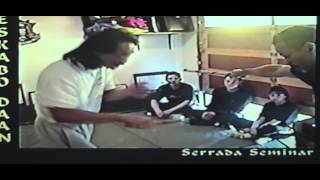
Back around the year 2000, prior to flying into Berlin, Germany, SGM D, conducted a special 'D/C Serrada System of Escrima' seminar at the San Francisco, California, home/dojo location of Grandmaster Guru Rob Castro. This was just one pre seminar stop-over out of many that SGM D, conducted before his international departure. 

Today Many of GM Castro's students have gone on to become recognized FMA Instructor's in their own rights. The blessings, gifts & ancient techniques of the 'Cabales Serrada System of Escrima were first bequeathed over to the legendary Great Grandmaster Guru Angel O. Cabales by way of his Guru/ teacher Felicisimo Dizon in the Philippines, then from GGM Angel Cabales to his many hundreds of graduate students, then from his students, to their students. In this way, the ancient fighting system has been preserved from one generation to the next possibly for many hundreds of years. 

This art was kept secret by GGM Angel Cabales, until he opened up the very first public Escrima school in Stockton, California, in 1966. Many students came through Cabales' academy doors such as, Professor Leo T. Fong, Guro Dan Inosanto, GM Richard Bustillo, GM Ted Lucaylucay, GM Graciela Casillas, GM Darren Tibon, Master David Mau, Prof. Sultan Uddin, GM Ron Saturno, GM Wade Williams, SGM Anthony Davis, Master Guru Jeff, Dr. Mark V. Wiley, Jeff Finder, and scores of others.

Friday, March 14, 2014

Ground Zero by GM Ron Saturno

I grabbed a 'short' Serrada stick last night to work out with. I was visiting the old Harding Way School where Angel Cabales started Filipino Martial arts on the mainland in 1968. There is 'a lot' of history in that building.
So many famous people have gone through the doors of the Harding Way School that I can only hope that it is never torn down for 'any' reason. If it should ever come up for demolition, it should be lovingly taken apart brick by brick and moved to another ...location and reassembled.
I couldn't help it when I was walking around to 'not' feel the energy of the place. Just a few blocks from the Cabales Serrada School Angel Cabales himself rests in a nearby cemetery. History. I was asked yesterday to sit down in the old school and speak about Serrada Escrima, Angel Cabales and the history of Filipino Martial Arts in Stockton, Ca. Stockton, Ca., is the epicenter, the very ground zero of Filipino Martial Arts in the United States.
The school on Harding way is sacred ground. It is 'the' very center of the epicenter. Serrada Escrima and Angel Cabales cannot be separated from this truth.
When someone asks you how it felt to have been trained by a legend? It's very hard to answer such a question easily. How can you describe your Master's gifted poetry in motion with his weapon? How can you abley describe in words the many fabulous skills of a renowned Master Martial Artist? How can you tell someone how lucky you truly feel to have been trained by such a man? How can you thank him in words and deeds long after his passing? I owe the man 'is all' that I can truly say and that I do try to push his art in any way that I can. I was placed into a corner last night to display my art on video.
I showed several basic moves last night, with another whole new generation of students standing and sitting nearby watching. I can only hope that in someway I inspired this new generation of students to continue learning the art of Serrada Escrima. It felt good to be back at the ground zero location where it all began.
When Angel Cabales started teaching Escrima at the Harding Way location, there were four Masters that soon started training there as well along with him. Max Sarmiento, Angel Cabales, Gilbert Tenio and Leo Giron were all at one time under the same roof. All of these men later went on to each become very famous in their own right and deservedly so. To be showing off my Escrima at such a rarified location made me have goose bumps.
To think that so many famous men and women came through the Harding Way location truly humbled me. Richard Bustillo, Dan Inosanto, Dentoy Revillar, Rene latosa, Mike Inay, Graciela Casillas, Jimmy Tacosa, to name just a few of the many. It felt good to be back at ground zero last night. It was a blast.

Tuesday, March 11, 2014

2nd Annual Manong Memorial in Stockton

This was the 2nd Annual FMA Ground Zero Memorial Event in Stockton, CA. Last year, we gathered together to remember the Big 3 Pioneers of Eskrima - Angel Cabales, Gilbert Tenio & Leo Giron

Sunday, March 9, 2014

A Happy Marriage by GM Ron Saturno

"Master Saturno: When do you feel that you're doing your most effective training?", he asked. 'He' is a guy standing next to me at a recent seminar that seemed to have a knack for asking the right questions. I quickly replied to him, "When I perform the solemn duty of a priest". "When I can marry my art with a mans Reptilian Half...then I will have done my job", I then said. "My job is to bring the two of them into holy wedded matrimony", I then said. A man learns best when he is challenged and in a nurturing environment. He learns quite well when his learning process is done in a story. All kinds of brain chemicals get released when a man is 'stimulated' in the process of his learning. Some of those chemicals get us euphoric: They get us high. This is why we love our Senseis. He's kept us high. We love, respect and appreciate him very much for this. It's a good high. Its legal and healthy to get high with our martial arts. We're hooked many times on brain chemicals that mimic morphine. You've never wondered why you find it so stimulating to attend class? Those hard fought Kumite, Rendori, Stick Sparring and rough play workouts in class have made many a martial artist an addict. Black Belt? You're a drug addict. I'm a dopamine addict my damn self. We in the martial arts are addicted to the rush of fast feet, fast hands, fast weapons, challenges and extreme focus. Throwing the dice and taking chances is also an important part of most mens very makeup. Dodging hands, feet, sticks and knives is another form of gambling. You are betting that you can hit them, before they can hit you. Martial Arts 'can' provide a stable, sure and meaningful way for us to enjoy our many vices. We like to gamble, we like or drugs, we like like to hang out with our Reptilian selves: Martial artists are Biker's in GI's! OK! I've gone too far....but, martial arts 'are' best done by a man in his reptile costume and practicing the dirtier version of his respective art. There I've said it. Martial does imply the military. The military doesn't train their G.I's to cuddle, "They train them to put you in a bloody puddle." The mental focus, time-in and dedication that it takes us to achieve competence in the martial arts is enormous. But if the man or woman who has achieved martial arts competence hasn't 'yet' gotten married to their Reptilian Half: They are still 'not' fully functioning martial artists. In order for us to survive under the very worst of conditions, we can't survive for very long alone. We 'need' a partner. We 'need' to have a 'mate' that will have our back: We need to get married and quickly, when we find ourselves in dire circumstances. We will 'need' to quickly marry our reptilian half. I cannot deny the fact that even when I teach the basics I am desensitizing my students about hitting another human being. Me personally? I don't give much of a shit any more about hitting another human being, other than if I can hit someone under extreme pressure and duress. My playing now days is mostly cerebral, but I do love my martial arts in its many forms. Now days my focus is primarily upon teaching a student to prevent a fight. My secondary focus is to teach them how to quickly recognize a threat that could lead to a fight. My least focus is upon teaching fighting. After a while of training with me I teach through story. Activating the 'mind' of a student is a sheer joy. I teach students how to gamble. I help them become drug addicted. I get them married. I keep them away from home and send them home bruised and tired, I guess that I am a bad man, but they wouldn't have it any other way

Tuesday, January 28, 2014

Atillo Balintawak - Saavedra Eskrima Successors; My Observations and Comments

      This essay is a re-posting that was originally published in the FMA Informative #108 that was released on Saturday, January 25, 2014.  I have added the revised and updated linear charts for Professor Remy Amador Presas and myself .  I understand that there will be some people who object to my charts, but I challenge them to do their own research, cite sources and show us where we are in error.  Until they can document their objections there is nothing that they can say that has any merit or that anyone should consider as being relevant.

Jerome Barber, Ed. D.
___________________________

Atillo Balintawak - Saavedra Eskrima Successors; My Observations and Comments

                On July 10, 2013, GM Crispulo Atillo posted a notice on his FB site announcing his official listing of the Atillo Balintawak Eskrima, Masters, Disciples and Successors-Disciples.  That notice was duly reported in the FMA informative, Volume 12, Number 8, on page 17.  I’m not going to repost the notice here but I would like to comment on several things related to the notice because in my opinion GM Atillo did a very smart thing publicly naming those people who he wants to see carry on the Atillo Balintawak –Saavedra Eskrima tradition in the future after he passes on. 

Historically there is usually a very large, nasty and ugly intra-system fight among the top students after a GM has passed away.  Sometimes the fights have included family members battling amongst themselves and with some non-family members of the organization.  Everyone will claim that they are the best qualified people to take over the leadership responsibilities of the system while their opponents are phonies and under-qualified status seekers.   These fights are never pretty, they drag on for many years and splinter groups are formed with each claiming to be the only true lineage of the art.  I watched from the sidelines as this very thing happened in Modern Arnis after the illness and passing of the late Professor Remy Presas.  The bickering was very disturbing to watch and worse yet was the fact that I knew some of the people participating in the fight.  I refused to get involved or support any of the participants. 

GM Atillo’s listing of Masters, Disciples and Successor-Disciples is a wonderful gift to all of us who have trained with him and learned from him. Those people named on the list are clearly legitimate heirs and the next generation of Atillo-Saavedra Balintawak Eskrima leaders.  He clearly states that the list members are the only legitimate proponents of his system and all others are acting on their own and without his official sanctioned endorsement.  This endorsement is better than being named in a will because it allows everyone who is interested to ask GM Atillo directly why someone was left off the list.  It eliminates the shill argument that the endorsements are misleading or falsely contrived by someone other than the GM.  If only Professor Presas had compiled a similar document and made the listing public prior to falling ill in 2000. 

I want to congratulate everyone named on the GM Atillo’s list.  In addition I also want to especially recognize three (3) people on the list who I know personally, GM Tom Bolden, Master Peter Vargas and Master Douglas Pierre.  All three of these men are personal friends and associates of mine who I have known and trained with for the past 24 years.  Given the fact that these men are being acknowledged by GM Atillo with the highest honor of being listed asSuccessors-Disciples, speaks volumes regarding their martial arts skills, personal dedication and integrity. 

The fact that I am referencing these three men should not be construed as a slam against the other people named to the same position by GM Atillo.  It is simply that I do not know any of the others personally and have not trained with them in the past therefore I can comment on them from my own personal perspective as a martial artists and teacher.

The Successor-Disciple award recognition is doubly impressive to me because of the fact that GM Bolden and Master Vargas is a teacher-student pairing.  This is as far as I can recall in my 35 year career in martial arts the first time that I have seen or heard of a teacher-student pair being promoted at the same time and within the same organization.  I also want to point out that GM Bolden, GM Pierre and Master Vargas, are the only Modern Arnis trained people on GM Atillo’s successor listing.  This is quite significant because most of the so-called Modern Arnis leaders in the post-Remy Presas era that began in 2001 after the passing of the system founder and GM have studiously avoided acknowledging or working with these three men.  These three men have been characterized as minor or marginal players in the Modern Arnis world, in spite of the fact that GM Bolden and GM Pierre were instrumental in building a following for the late Professor Presas in the Mid-Hudson and NYC regions respectively. In fact it was GM Bolden who first brought the art and Professor to the eastern side of NYS and along the Hudson River Valley between Albany and NYC in the mid 1980's. 

The MoTTs (Masters of Tapi-Tapi) and the WMAA (World Modern Arnis Alliance) leaderships were adamant that anyone not associated with their respective groups were not and should not be considered as Modern Arnis Players.  The heads of the aforementioned groups would not recognize the rank certificates issued by Professor Presas and insisted that everyone who joined their organization would have to be re-tested under the new organizational rules and standards.  These same leaders, through their own students/associates were also quite critical of Master Peter Vargas because he had not trained directly with the late Professor.  That standard is very interesting because if one applies it across the board to everyone some of their own students in 2001 and beyond could not be considered authentic Modern Arnis students because those people had never had the opportunity to train under Professor Presas at a seminar or camp.  I have been criticized for bring up the re-testing rule of both the MoTTs and WMAA, but since I spoke with Dr. Randy  Schea, Mr. Jeffery Delaney (MoTTs) and Mr. Timothy Hartman (WMAA) personally and through e-mail exchanges, there is no doubt in my mind about their positions in 2002 on the matter of rank recognition.  Their current associates can decry my statements as loudly and often as they wish, none of those people were part of my conversations with these three men in 2002.  If these organizations have subsequently changed leaders and/or policies that is fine with me and I am not making an argument that nothing has changed since 2002.

There is also the matter a good number of Modern Arnis and Balintawak Eskrima people in the USA are not willing to recognize GM Crispulo Atillo as a senior Balintawak practicitioner whose credentials go back to 1953 when joined the newly formed Balintawak Self Defense Club as a charter member.  The BSDC was founded  in Cebu City, Philippines by Venancio Bacon, Delfin Lopez and Vincente Atillo with Bacon serving as the lead instructor and Atty. Eulalio Causing as club president. (Cebuano Eskrima,  Neprangue & Macachor,  p.167).

   The BSDC was the first group to utilize the word “Balintawak” in its club name wnd the first spin-off from the BSDC was the Balintawak International Self defense Club led by GM Jose Villasin and GM Teofilo Velez in 1957.  GM Crispulo formed the “Ogok Gang” in 1957, which consisted of a number of younger Balintawak stylists from the BSDC and in 1975 GM Atillo founded the Philippine Arnis Confederation.   (Cebuano Eskrima, p. 170).   He later changed the organizational name to the World Balintawak Arnis-Eskrima Association after Marcos era of martial law ended in the Philippines.

 GM Atillo is among the last of the people who knew the Saavedra's, Lorenzo and Doring, personally.  His art is the closest thing that we have to the original Saavedra Eskrima System, which is also known more popularly as "Balintawak Eskrima".  Couple that fact with the reality that Crispulo Atillo assisted his father, GM Vincente Atillo, with teaching the art of Balintawak to a future Balintawak GM Arnulfo Mongcol, who in turn was Professor Remy Presas’ first Balintawak instructor.  This is a significant set of connections because the Saavedras were the instructors of GM Bacon, GM Lopez, GM Timeteo Maranga and GM Vincente Atillo and all four men trained under GM Teodoro “Doring” Saavedra prior to WWII at the Doce Pares Club in Cebu City.  Some of the training sessions took place at the Atillo home and the younger Crispulo Atillo knew all of people mentioned in this paragraph and witnessed their training sessions at his home.  He formally began his eskrima training under his father Vincente Atillo at the age of 14.  He was trained in the Saavedra system of eskrima and credits his father as his instructor.  GM Atillo maintains that there is no real difference between Saavedra Eskrima and Balintawak Eskrima  other than the name used.  After training with GM Bobby Taboada for 4 years in the Toevel’s Balintawak system, plus viewing a number of Balintawak people on YouTube such as Nick Elizar, Bob Silver Tabimina and Henry Jayme, I have to agree with him on this point.  The differences are not significant and they all can easily be identified as Balintawak people.

The Atillo’s taught GM Anfulo  Mongcol, who in turn served as Professor Remy Presas' first Balintawak instructor.  Afterwards, the young Remy Presas was passed along to GM Timeteo Maranga for further training.  GM Maranga was a classmate of GM Vincente Atillo, GM Bacon and GM Delfin Lopez under the Saavedra's.  The network couldn't be any tighter and we must keep in mind that Balintawak forms one (1) aspect of the five (5) arnis methods that are at the root of Modern Arnis.  These five roots as mentioned by Professor Presas in some interviews are Balintawak, figure 8 striking, banda y banda striking, palis-palis method and crossada method.  The latter two methods are espada y daga styles of mid to long range fighting and were taught to Professor by his grandfather, Leon B. Presas, who was Professor’s first arnis/eskrima instructor at the age of 6. 

Based on the information cited above, I will re-write my own lineage chart to reflect the newest information that I have found regarding the roots and lineage of Professor Remy Presas through my immediate Modern Arnis and Kenpo Instructor, Sifu Donald F. Zanghi to myself and beyond to the students who earned their black belts and instructional certifications under me.

GM Tom Bolden, Master Douglas Pierre and Master Peter Vargas have been training with the man who indirectly helped to establish part of the foundation for Modern Arnis.  They have been acknowledged and accepted by GM Crispulo Atillo as highly skilled practitioners of the Atillo-Saavedra connection to Modern Arnis.  I am extremely happy for them and wish each of them even greater success in the future.

Sincerely,

Jerome Barber, Ed. D.,                                                                                                                                     Grand Master, Datu & Principal Teacher                                                                                           Independent Escrima-Kenpo-Arnis Associates  


Modern Arnis Lineage Chart of Founder/GM Remy Amador Presas

 Leon B. Presas /                                                                                                                                                Traditional Arnis: Palis-palis, Crossada, Banda y Banda, Figure 8,

                  |

                    |                                  Arnulfo Mongcol – Balintawak Instructor

                    |                                                 |

                    |                                  Timeteo Maranga – Balintawak Master

                    |                                                 |

                    |                                  Venancio Bacon – Balintawak GM

                    |                                                 |                                         

       Remy Amador Presas – Founder, Grand Master, Professor,

           Modern Arnis – International Modern Arnis Federation

Palis-palis, Crossada, Banda y Banda, Figure 8, Flow, Up & Down, Abanico,                                 Rompida, Espada y Daga, Stick & Sword Disarming, Trapping Hands, Redonda, Single/Double/Reverse Sinawali, 12 Zone Striking, 12 Zone Striking Defense


Saavedra Eskrima and Balintawak Eskrima Lineage to Modern Arnis

Lorenzo Saavedra – Founder

                |

        Teodoro (Doring) Saavedra – Master Instructor

                |                                   |                                     

Venancio Bacon  -  Timeteo Maranga  -  Vincente Atillo (Balintawak)

                |                                    |                                      |               

                |                                    |                        Crispulo Atillo

                |                                    |               (Saavedra & Balintawak)

               |                                    |                                       |                                                                                         

               |                                    |                        Arnulfo Mongcal

               |                                    |                     Balintawak Instructor

               |                                    |                                      /

Remy Amador Presas – Founder, Grand Master, Professor,

    Modern Arnis – International Modern Arnis Federation

Palis-palis, Crossada, Banda y Banda, Figure 8, Flow, Up & Down,  Abanico, Rompida, Espada y Daga, Stick & Sword Disarming,  Trapping Hands, Redonda, Single/Double/Reverse Sinawali, 12 Zone Striking, 12 Zone Striking Defense


Martial Arts Lineage of Dr. Jerome Barber

Modern Arnis Lineage:

            Remy Amador Presas,  Founder & GM -  Modern Arnis                            

                                    |                              |

              Donald F. Zanghi       Vincente Sanchez

                       |_______________|

                                       |

                     Jerome Barber, Ed. D.                                                                                                    

             GM, Datu & Principal Teacher,  

     Independent Escrima Kenpo Arnis Associates

Kenpo Karate Lineage:

Hoon Chow 

(Hung Gar)         James Mitose

          |                   (Kosho Ryu Kenpo)

           |                             |

William K. S. Chow (Chinese Kenpo)

        |

Adriano Emperado (Chinese Kenpo, Eskrima, Kajukenbo)

        |                                                             |

Marino Tiwanak                                Edmund Parker, Sr.

(Kajukenbo, CHA-3 Kenpo)     (Chinese Kenpo, American Kenpo)

       |                                                                        |

Florentino Pancipanci                                Al & Jim Tracy

(CHA-3 Kenpo, Pancipanci Eskrima)    (Tracy System of Kenpo)

|                                                                          /                            |

Tom Bolden                           Ernest McPeek              Donald F. Zanghi

(CHA-3 Kenpo)             (Tracy System Kenpo)     (Tracy System Kenpo)

(Pancipanci Eskrima)                            |                         (Modern Arnis)           

(Modern Arnis)                                        |                                  |

           |____________________________|_________________|

                                               |

                       Jerome Barber, Ed. D.,

               GM, Datu & Principal Teacher,

      Independent Escrima Kenpo Arnis Associates                                     

__________________|_____________________________

       |                                      |                                    |                                   |                              

Tim Kashino - Richard Curren - Tom Verga - Paul R. Martin - Kenneth Q. Boehm

Debra S. Moore - Keith Roosa - James “Buddy” Antonio - Frank Heinan

Kathleen Geiger - Mary Altair - Keri Marotti – Frankie Heinan – Stephanie Heinan

Michael Zelli      (Certified IEKA Black Belt Instructors)

Additional Martial Arts Influences for Dr. Jerome Barber:

Bram Frank, Billy Bryant, Dan Donzella, Bobby Taboada, Abundio Baet,                                                       Eddie Lastra, Ric Jornales, Roberto Torres, John Kovacs, David Battaglia,                                             Ernie Delts, Dan Carr

--
Posted By Jerome Barber, Ed. D. to SE Asian Martial Arts at 1/28/2014 04:06:00 PM

Saturday, January 11, 2014

Pure Simple Mathematics by GM Ron Saturno

You can't go back faster than a man can come forward. You can't come forward faster than a man can side step out of your path. I was once teaching an algebra class and was playing with the Pythagorean Theorem. The theorem solves passing issues and can accurately determine speeds and distances that weapons will travel and their direction. The center leg of a triangle moves faster than the other leg and the hypotenuse of a triangle. Hence, the safety of side stepping is based on mathematics, pure and simple. This is the proper way to deal with the heavy hitters. Side step them. I am shocked at how many times that I've seen men attempting to defend themselves against a hard hitting man and freeze, or even try to out hit their hard hitting attacker. I do understand that you do have to do something, but trying to out hit a man who hits harder than you may not be the most correct answer. I was watching the teacher of GM Marc Lawrence a few months ago. Marc's former Master really Isn't that large of a man, but he is muscular and hits like a small truck would hit you running through a red light in an intersection. I like Marc's former teacher, he is very serious and dedicated to his art. He had great skills many years ago when I first saw him perform, he is even better now and hits even harder than when I first saw him perform. Damn, it's pretty hard. I wouldn't want to be at the other end of his weapons, should he seriously mean to come after me. What I wouldn't do would be to try and out power hit this hard core power hitter. Out would come the Pythagorean Theorem and proof of my need to side step the power. It's just hard to hit something that just Isn't there to hit. It has surprised me how many times that math has solved my martial problems. The great Escrimadors may not have had any formal training in higher math, but they were great problem solvers who innately used math non-the-less. The great Escrimadors had a self-taught Ph.D in higher mathematics. My art of Serrada Escrima is deeply based upon applied math principles that helps make Serrada Escrima an inherently fast art. Basic Serrada is a great FMA that can make a man capable of defending himself in six months or less. This is fairly fast by most martial arts standards. Perfecting the upper level skill sets of Serrada Escrima takes a life time. We get really large jumps in skill level in the beginning with relatively little effort, but after the first few months elevating your skill level starts to become much harder. It will then take lots of effort to gain small increases in skill level. There is an equation here. Nothing good is cheap or easy. I can only but laugh my ass off at the periodic advertisements that promises (guarentees) you the ability to be able to defeat seasoned street fighters and upper level Black Belts with just $69.95 and a few hours of watching a DVD. In the end my late teacher Angel Cabales didn't really have to do much to kick my ass. He didn't move fast and he didn't hit appreciably hard: But, that didn't stop him from pissing on my Escrima parade on any given day of the week. Manong Angel knew what to do and when to do it. This is priceless. He had little or no wasted effort when he performed. He had near perfect timing. He had five decades of experience. He could perform through his fears and wouldn't hesitate to hit you. Applied math skills...you bet ya'. Knowing what to do and then being able to do it without any glitches is proof of great skill. But, this really wasn't his true forte! More importantly, Angel Cabales knew what to do when things didn't go right. He could quickly change up on real time and still find a way to beat you. Was it arcane math that allowed him to accomplish this? In a word, yes. He may not have been able to explain this via formulas, but after years of studying mine and his art: It was math that allowed him to become and remain a great martial artist. Movement, power, distances, time, leverage, etc., is all about math. It is kind of hard to start looking upon great martial artists as consumat mathematicians, but that they are. So here is my salute to math and the great martial artists who perfected maths use in their arts.